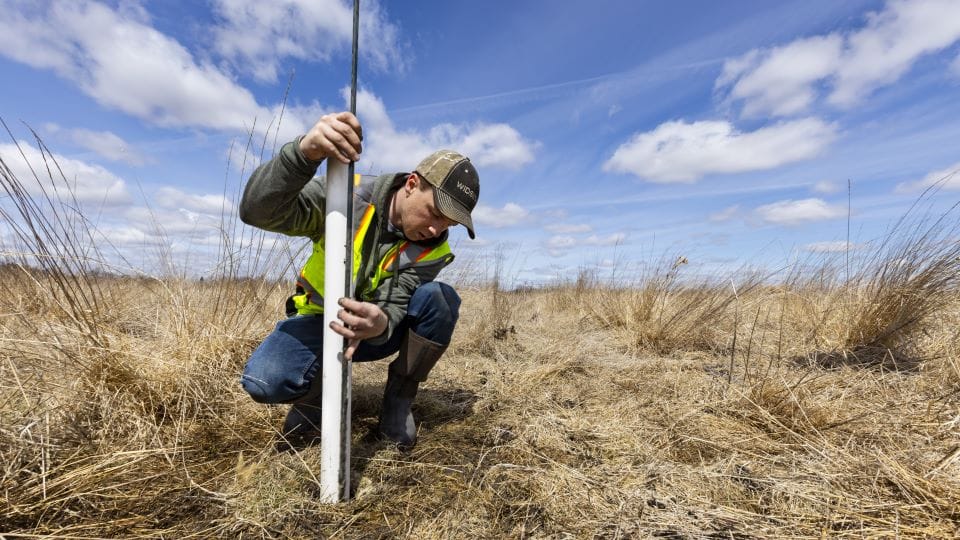
Joey Goeden, a Widseth environmental scientist, installing a well.
As developers know, a commercial building’s journey begins long before the ribbon is cut or the first shovel breaks ground. The first step is investing in the land on which the building will ultimately rest. When selecting an appropriate site for their project, developers would be wise to consider potential environmental concerns in the early stages. Local, state, and federal governments have passed laws to protect environmental resources, as well as historically significant sites, through permitting and conservation regulations. While environmental permits are not always required, the best way to ensure compliance with applicable regulations is to conduct a thorough environmental review. Skipping this step can result in unexpected costs or delays in project construction.
The environmental review process typically includes evaluating existing and proposed conditions, determining alternatives, and preparing a written environmental report. Here are four specific environmental hurdles every developer should have assessed when they are in the beginning stages of their commercial project, along with how Widseth can help:
- Wetlands: Navigating Permits, Mitigation, and Site Limitations
Prospective properties should be assessed for wetlands before purchase. The federal Clean Water Act requires the preservation of jurisdictional wetlands and bodies of water, thus limiting developers’ flexibility when building on property with these natural features. Wetlands can impede development in multiple ways: an abundance may mean there is not enough space for the structure itself; their location may conflict with the placement of auxiliary features, such as access roads; and offsetting impacts by purchasing the necessary wetland mitigation credits could be extremely expensive. As a result, properties with wetlands present can sell at a steep discount compared to readily developable sites. While it may look like an affordable piece of land, a thorough wetland delineation can help determine if a site is worth purchasing or if developers are better off looking elsewhere.
Widseth’s environmental services include wetland delineation and permitting assistance to keep clients compliant with the Clean Water Act and the Minnesota Wetland Conservation Act. Our environmental scientists use three key criteria—hydrology, soils, and vegetation—to determine the presence of wetland conditions at a site. Prior to construction, we can help developers sequentially follow three rules—avoid, minimize, mitigate—to gain approval for wetland impacts or obtain a public waters work permit through the Minnesota DNR. - Environmental Site Assessments (ESA): Uncovering Hidden Property Risks
While ESAs are not governmentally mandated, they are often required by lenders prior to financing a property transaction. It is considered a developer’s due diligence to have an ESA conducted to avoid hindering their project.
A Phase I ESA is a process that determines potential environmental concerns on or near a property through a review of public records, documents, interviews, and databases. The assessment also includes site reconnaissance to collect information on current environmental conditions and preparation of a summary report that lists any recognized environmental conditions (RECs) associated with the property.
Widseth has conducted hundreds of Phase I ESAs, and our environmental scientists can arm developers with expert knowledge and advice on the risks of purchasing and building on the assessed property. If there are any documented RECs on the site, Widseth can also conduct a Phase II ESA to evaluate potential impacts to environmental media (soil, groundwater, and soil vapor), as needed. - Contaminated Soil: Managing Cleanup and Regulatory Requirements
Parcels of land on or adjacent to properties previously developed as gas stations, laundromats, or pesticide/fertilizer facilities may have contaminated soil and groundwater from chemicals that seeped into the ground. If such structures are known to have been in place, Widseth can conduct a subsurface investigation to determine the presence, type, and extent of the associated contamination. We assist clients in working with regulatory staff at the Minnesota Pollution Control Agency (MPCA) or Minnesota Department of Agriculture (MDA) to determine how to move forward in an environmentally friendly and fiscally responsible way. - Project Scope: Understanding Environmental Review Thresholds
An Environmental Assessment Worksheet (EAW) is a document designed to summarize the basic facts of a proposed project, as well as its potential for significant environmental impacts. Depending on whether the project meets the mandatory thresholds listed in MN Rules Part 4410.4300, an EAW may be required. EAWs can be expensive and time consuming, so knowing the thresholds that trigger one can potentially save a developer’s project thousands of dollars.
Knowing the scope of the potential project helps predict the time, money, and effort that will be needed. Widseth staff can evaluate the project early in the process to help determine the need for an EAW, ensuring compliance with regulations. If required, we can complete an EAW and provide the necessary supporting documentation for the project.
Widseth has experience in all aspects of environmental due diligence and regulatory compliance. We offer services including wetland delineations and permitting, Phase I and Phase II ESAs, above ground and subsurface investigations, and project review to assess potential impacts. We provide the tools developers need to make educated decisions on how to move forward with their project. If you have questions about environmental permitting and due diligence, contact Widseth for help.